
Past Reports
Working Together
In addition to ERRN’s Annual Thematic Report, this section provides access to a range of past reports published by ERRN through two main avenues:
(i) ad hoccollaboration with external organisations; and
(ii) the ERRN Research Collaboration Initiative, which ran from 2014-2022 with the aim of developing’ research collaborations between electoral commissions and academia in order to address the long-term challenges facing the regulation of Australian elections.
A Wealth of Analysis
The reports below address a wide range of electoral regulation and management issues at the city, state, and federal levels in Australia, as well as the Asia-Pacific region. Together they provide a wealth of reports, analysis and data that has helped to inform practitioners, policymakers, and scholars in their work. You can find more information below.
Latest Report
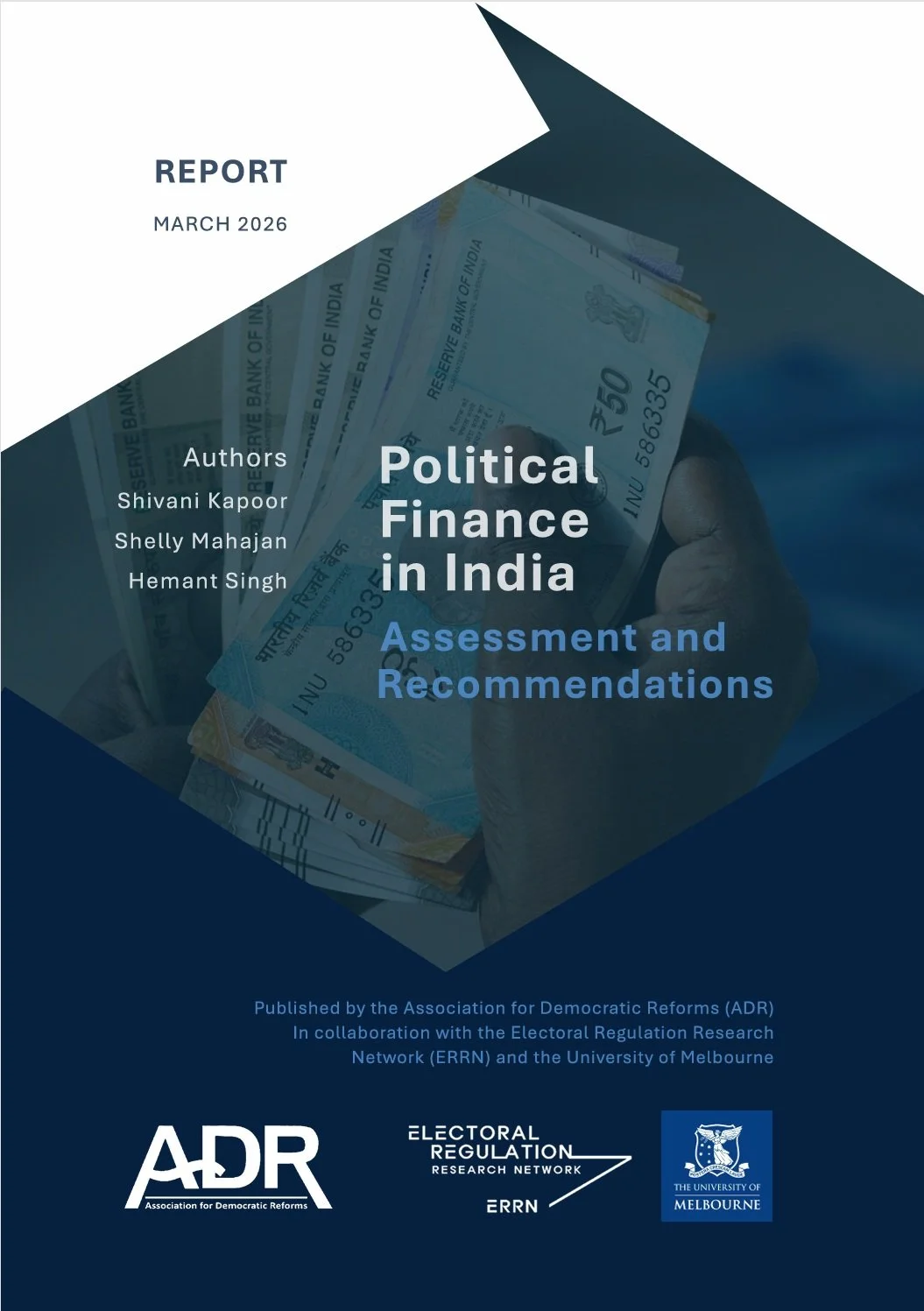
Political Finance in India: Assessment and Recommendations
Published by the Association for Democratic Reforms, India in collaboration with ERRN
March 2026
India's electoral democracy faces profound challenges from the pervasive influence of money, often termed "money power”, which undermines political equality, transparency, and fair competition. This landmark report seeks to assess India’s political finance system, to understand its limitations and how it fares on parameters of electoral integrity, transparency, and equality. Download the full report in PDF format below. You can also access the Executive Summary online.
-
Shivani Kapoor is a Program Lead and Manager with the Association for Democratic Reforms (ADR). Currently, she heads the legal work of the organization.
Shelly Mahajan is a Program and Research Manager with the Association for Democratic Reforms (ADR), with more than seven years of experience. Currently, she heads the Political Party Watch team, which analyses the official data on funding and expenditure of all registered political parties in India.
Hemant Singh is a Program Associate at the Association for Democratic Reforms (ADR) with over 16 years of experience in the social sector, focusing on political finance, transparency, and democratic accountability in India.
-
India's electoral democracy faces profound challenges from the pervasive influence of money, often termed "money power”, which undermines political equality, transparency, and fair competition. The report attempts to undertake an assessment of India’s political finance system, to understand its limitations and how it fares on parameters of electoral integrity, transparency, and equality. It traces how unregulated money often from illegitimate or opaque sources has become central to Indian politics, creating an uneven playing field where wealth dictates political power. Despite decades of reform proposals, the nexus between money, crime, and politics persists due to weak legal enforcement, inadequate regulation, and complete lack of political will. The report highlights that financial dominance—not ideology or public service—determines political success in India. The lack of transparency and accountability in political funding has fostered corruption, unequal access to political power, and policies influenced by vested interests.
The report maps out the nature and extent of digital campaigning in the Asia and the Pacific region, with a focus on five country case studies (Australia, India, Indonesia, Japan and Kyrgyzstan), and it studies the regulation of digital campaigning under political finance laws. It analyses the democratic implications of digital campaigning for political finance and its regulation. Recommendations are provided for regulating the nexus between digital campaigning and political finance to enhance the benefits of digital campaigning for democracies in the Asia and the Pacific region.
-
The official disclosures by political parties and candidates are based on the information available on the Election Commission’s website. ADR does not add or subtract any information unless the EC changes the data. The data can be accessed from the website of the ECI, and other sources mentioned in the introduction chapter and bibliography. In particular, no unverified information from any other source is used. While all effort has been made to ensure that the information is in keeping with what is mentioned in the statements submitted by the political parties, candidates and other sources, in case of discrepancy between information in this report and that given in their statements, the information reported by the original references should be treated as correct. Association for Democratic Reforms (ADR), National Election Watch (NEW) and their volunteers are not responsible or liable for any direct, indirect special, or consequential damages, claims, demands, losses of any kind whatsoever, made, claimed, incurred or suffered by any party arising under or relating to the usage of data provided by ADR through this report.
It is to be noted that ADR undertakes great care and adopts utmost due diligence in analyzing and dissemination of the audit, contribution and Elections Expenditure reports of the political parties; affidavits and expenditure statements of candidates submitted with the Election Commission of India and respective state CEOs. Such information is only aimed at highlighting the increased misuse of money in our electoral and political process so as to facilitate a system of transparency, accountability and good governance and to enable voters to form an informed choice. Therefore, it is expected that anyone using this report shall undertake due care and utmost precaution while using the data provided by ADR. ADR is not responsible for any mishandling, discrepancy, inability to understand, misinterpretation or manipulation, distortion of the data in such a way so as to benefit or target a particular political party or politician or candidate.
This report is based on data available at the time of writing and has been updated till December 2025. Although the authors have taken due care to use the most current data available at the time of finalization of the report, however, given the evolving nature of the data sources, updates or revisions to the underlying datasets may occur between finalization and public release.

Digital Campaigning and Political Finance in the Asia and the Pacific Region
ERRN Research Collaboration Initiative
2022
-
Professor Joo-Cheong Tham (Director, Electoral Regulation Research Network)
Professor Andrea Carson (Department of Politics, Media and Philosophy, La Trobe University),
Amy Chinnappa(Lawyer and Policy Consultant)
Adhy Aman (Senior Programme Manager, International IDEA)
-
The report studies the intersection between digital campaigning in elections, and political finance and its regulation in Asia and the Pacific region. In so doing, it connects the digital disruption with an existential threat to democracies across the world―money in politics. Political finance not only poses the danger of ‘policy capture’ but also, in worse scenarios, state capture by monied interests.
The report maps out the nature and extent of digital campaigning in the Asia and the Pacific region, with a focus on five country case studies (Australia, India, Indonesia, Japan and Kyrgyzstan), and it studies the regulation of digital campaigning under political finance laws. It analyses the democratic implications of digital campaigning for political finance and its regulation. Recommendations are provided for regulating the nexus between digital campaigning and political finance to enhance the benefits of digital campaigning for democracies in the Asia and the Pacific region.
-
The report for this project is available here.
-
On 25 October 2022, the Digital Campaigning And Political Finance In The Asia And The Pacific Region report was launched at the University of Melbourne.
The report was officially launched by Dr Kevin Casas-Zamora (Secretary-General, International IDEA), with opening remarks by Adhy Aman (Senior Programme Manager, International IDEA), Warwick Gately, (Victorian Electoral Commissioner and ERRN Governance Board member). The launch featured a panel of speakers providing commentary and a discussion with the report's authors with was moderated by Leena Rikkila Tamang (Director of Asia and the Pacific Region, International IDEA). A video on the recording can be viewed below.
Speakers in the recording:
Adhy Aman, Senior Programme Manager, International IDEA (opening remarks and moderator)
Warwick Gately, Victorian Electoral Commissioner and ERRN Governance Board member
Dr Kevin Casas-Zamora, Secretary-General, International IDEA
Professor Joo-Cheong Tham, Director, Electoral Regulation Research Network
Leena Rikkila Tamang, Director of Asia and the Pacific Region, International IDEA (Q&A moderator)
Tom Rogers, Australian Electoral Commissioner
Major General Anil Verma (Retd), Head, Association for Democratic Reforms, India
Professor Andrea Carson, Department of Politics, Media and Philosophy, La Trobe University
Amy Chinnappa, Lawyer and Policy Consultant

Regulating Money in Democracy: Australia's Political Finance Laws Across the Federation
ERRN Research Collaboration Initiative
2021
-
Dr Yee-Fui Ng, Senior Lecturer, Faculty of Law Monash
-
This report provides a comprehensive overview of the current regulation of political finance laws across the federation. Part I outlines the scope and impetus of this report, which is commissioned by the Electoral Regulation Research Network.
Part II provides an analytical framework of principles for political finance regulation. These principles are: protecting the integrity of representative government, promoting fairness in politics, the principle of transparency, supporting parties in performing their functions, and respecting political freedoms. It also provides regulatory options to promote these principles, such as transparency measures, supply-side measures such as source restrictions which regulate who can make financial contributions; and amount restrictions that limit the sums that can be given, as well as public funding of electoral campaigns.
Part III outlines the history of major legislative changes to electoral legislation at the Commonwealth, State and Territory levels in Australia. Australian jurisdictions have previously had minimal regulation of political finance that was described as laissez faire or “lackadaisical” compared to other major democracies. In recent years, however, several Australian State jurisdictions have undertaken various dynamic political finance reforms that have tightened up the regulatory net, particularly Victoria, NSW and Queensland.
Part IV identifies nine key elements of political finance regulation: disclosure requirements (donations and expenditure), caps on donations, caps on expenditure, indexation, bans on donations from certain sectors, foreign donations bans, political funding streams and funding rates, and enforcement. It examines and classifies these key elements of political finance regulation for all jurisdictions in Australia. It shows that there is a distinct lack of uniformity in the regulation of political finance in Australian jurisdictions at the Commonwealth, State and local government levels in all nine regulatory dimensions.
Part V provides recommendations for law reform and harmonisation across jurisdictions.
-
Part V provides recommendations for law reform and harmonisation across jurisdictions as follows:
Transparency Measures: Disclosure Requirements
administrative harmonisation across jurisdictions in terms of website functionality and visualisations for disclosures utilising user-friendly interfaces.
administrative harmonisation in terms of the format, accessibility and timing of disclosures of electoral expenditure.
Regulation of the Supply and Demand of Money in Politics
consideration should be given towards broader adoption of donations caps in Australian jurisdictions to promote political equality.
there should be policy harmonisation of adoption of caps on expenditure for all Australian jurisdictions to promote equality between the parties and dampen the demand for electoral money.
consideration of broader adoption of bans on foreign donations across Australian jurisdictions to enhance public integrity.
Public Funding
consideration should be given towards adopting the SA public funding model of paying a higher fixed-dollar amount for the first tranche of the vote a party attracts, than for the rest of the vote share it wins.
policy harmonisation that streamlines the level of public funding across jurisdictions, provided that this is coupled with electoral expenditure caps.
policy harmonisation in providing annual funding for parties, including new parties, to ensure that parties are adequately funded to promote their policy platforms.
Indexation
indexation categories should be harmonised across jurisdictions in terms of disclosure thresholds, donation caps, expenditure caps, and public funding.
harmonisation of the quarter of CPI adjustment across jurisdictions.
Enforcement
categories of offences should be harmonised across jurisdictions in terms of breach of disclosure requirements, donation caps and bans, and expenditure caps.
penalties for breaches should be confined to fines or civil penalties, rather than imprisonment or criminal penalties.
-
The report for this project is available here.

Implications of Changes to Voting in Australia
ERRN Research Collaboration Initiative
2022
-
The multi-disciplinary project team conducting the research includes:
three political scientists (Rodney Smith and Stephen Mills from the University of Sydney, and Martin Drum from the University of Notre Dame, Western Australia);
five computer scientists (Annabelle McIver from Macquarie University, Carroll Morgan, Richard Buckland and Roland Wen from the University of New South Wales, and Ian Brightwell, who previously worked for the NSW Electoral Commission); and
two electoral commission officials (Mark Radcliffe from the NSW Electoral Commission and Justin Harbord from the Western Australian Electoral Commission).
-
This report was prompted by the increasing numbers of voters in Australia who are ‘convenience voting’ in one way or another. This trend presents challenges for other stakeholders in elections, including electoral commissions and their workers, political parties and candidates. We focused on these stakeholders, examining the challenges raised by the range of voting channels now available in Western Australia and New South Wales elections. Research for the report included original online surveys, interviews and observations.
The online surveys showed that election workers tended to view voter convenience as less important than other criteria that centre on electoral integrity. The interview research showed that political parties and candidates accept voter convenience when it does not hinder them from effectively communicating with voters.
The online surveys suggest that few election workers experienced or observed problems carrying out their assigned tasks across a range of voting channels. The problems that did occur were generally not considered to be serious and were mostly dealt with successfully. On this evidence, the electoral commissions are handling the current mix of voting channels successfully.
The growing demand for flexible voting seems likely to continue. No single voting channel is likely to replace ordinary voting on election day as the new dominant form of voting. Instead, for the foreseeable future, different voters will want to use different voting channels.
Australian lawmakers, electoral commissions and election candidates all face continuing challenges to meet reasonable expectations among citizens that voting will be made convenient and easily accessible. One way of facilitating this would be to open access to the four most common voting channels—ordinary voting on election day, pre-poll voting, postal voting and remote electronic voting—to anyone who wants to use them. Citizens would then be free to access the ballot in the ways most suited to their needs.
-
Rapidly increasing numbers of Australians are voting early, via mail or electronically. We need to know more that we do about the implications of this trend for the key actors in elections. The research questions for this project are:
What challenges and opportunities does this trend present for Australian electoral commissions, election contestants and voters?
How prepared are these various actors for the challenges and opportunities of different forms of voting?
What could be done better to prepare these actors for these challenges and opportunities?
-
The project will adopt three main research methods:
Audits of electronic and paper-based voting channels against common criteria, using electoral commission data and records.
Interviews with Australian electoral commission staff, party officials and candidates.
Analysis of existing voter survey data and new surveys of voters.
The project will gather new data from three elections with a range of voting channels:
The Western Australian state election, due in 11 March 2017, which is likely to involve remote electronic voting alongside early, postal and ordinary voting for the first time in that state.
Two NSW state by-elections likely to be held in November 2016. These by-elections will use the iVote® system of remote electronic voting along with early, postal and ordinary voting.
A sample of NSW local government elections in September 2016, in which voting channels will be restricted to postal voting and ordinary voting.
-
The report for this project is available here.

The Desirability and Feasibility of Convenience Voting in Australia
ERRN Research Collaboration Initiative
2018
-
Matthew Laing
Narelle Miragliotta
Paul Thornton-Smith
-
Our study used a mixed method research design to explore how voters, legislators and electoral commissions perceive the challenges presented by the extension of convenience voting – both in terms of its growing use among electors and the liberalisation of its forms.
-
The findings suggest that these groups perceive the challenges associated with the expansion of convenience voting differently.
Voters showed awareness of the possible security risks associated with newer forms of convenience voting but trust that electoral authorities will manage and mitigate these hazards. Voters gave priority to a flexible voting experience.
Legislators expressed concern that convenience voting limited their opportunities to engage with voters during the election campaign period, especially early in-person voters. Many also gave voice to fears that convenience voting will erode democratic engagement. Legislators had a more cautious outlook towards convenience voting, placing a higher value on the security of ballot over voter convenience.
Electoral authorities stressed the multifaceted logistical challenges that the expansion of convenience voting presents for the integrity and efficiency of the electoral process. Their concerns centred on the management of these complex processes. Authorities emphasized the importance of enhancing the voter experience and the electoral process more generally. They sought to balance the goal of convenience against the values of security and efficiency.
Unsurprisingly, the stakeholders’ construction of the challenges that convenience voting can give rise to was consistent with their particular relationship to the electoral process. Yet leaving aside these differences, all agree that a paradigmatic shift in voting is ultimately underway.
-
The final report for this project is available here.

The Challenge of Informed Voting in the 21st Century
ERRN Research Collaboration Initiative
2018
-
Rodney Smith, University of Sydney
Anika Gauja, University of Sydney
Paul Kildea, University of New South Wales
Mel Keenan, Electoral Commission of New South Wales
Research Assistant: Charlie Cull
-
Electoral practitioners and observers routinely say that informed voting is important for democracy. They often lament the low levels of informed voting in Australia and elsewhere. What counts as informed voting and how it should be promoted are, however, questions that are difficult to answer. This research project is driven by four broad questions around the challenges of informed voting in Australia:
Why informed voting?
Why is informed voting valuable? How important is it for Australian democracy in the 21st century?
What is informed voting?
How has the problem of informed voting been understood by relevant formal and informal stakeholder institutions, such as governments, parliamentary committees, electoral administration bodies, courts, political parties and media organisations? How has it been understood by voters themselves?
How is informed voting currently fostered in Australia?
What information relating to voting is available from official and unofficial sources, how is it regulated, how is it delivered, and how effective is it?
-
How can informed voting be better promoted in Australia?
What concrete proposals might be implemented to help meet the challenges of informed voting in the 21 century?
Research for the project includes a critical survey of the ways in which bodies such as parliamentary committees, political parties and electoral commissions have addressed the challenge of informed voting to date. Existing survey data will be re-analysed to identify the factors associated with higher or lower levels of voter information. A series of focus groups will be used to tease out voters' perceptions about the information that they need and how it might best be delivered.
-
The final report for this project is available here.

Enhancing Local Government Democracy: City of Melbourne
ERRN Research Collaboration Initiative
2015
-
Ken Coghill, Monash University
Yee-Fui Ng, Monash University
Paul Thornton-Smith, Victorian Electoral Commission
Research assistant: Valarie Sands
-
This project will focus on the nature of local government democracy in the City of Melbourne. It aims to investigate the relationships that operate between the City of Melbourne and the wide range of people and organisations that use its facilities and services – residents, businesses, worker, commuters, shoppers ad others. It will examine how these relationships affect policy-making and the provision of facilities and services within the City of Melbourne. The project also aims to ascertain if policy-making and the provision of facilities and services are affected by the City of Melbourne's multiple franchise which includes a property-based franchise with deeming provisions (to a greater extent than other Victorian local governments) and voting by citizen and non-citizen resident tenants and owner-occupiers.
This will be the first known empirical study of the nature of the operation of local government in the City of Melbourne. The empirical aspect of the project will investigate the interactions between interest groups and formal democratic institutions.
As the project conceives of local government democracy as a complex evolving system, it goes beyond the boundaries of legislation and conventional political science perspectives and provides an innovative insight into the operation of local government in the City of Melbourne.
The project is expected to be completed by June 2014.
-
A random draw for the winners of the Survey about Local Government Democracy and the City of Melbourne was conducted at the Victorian Electoral Commission on Friday 16th May 2014.
The winners have been contacted and vouchers distributed to the three winners:
Mr Tony Merrett, Golden Square Vic 3555
Ms Tayla Austen, Ballina NSW 2478
Ms Samantha *****, Melbourne Vic 3004
Thank you to all other respondents who participated in the survey, which was conducted under the auspices of the Melbourne Law School, Victorian Electoral Commission and Monash University. Much useful data has been gathered to inform our research. Please check this site in July 2014 for publications on the Local Government Democracy and the City of Melbourne.
-
The final report for this project is available here.